


Content is King. Such a simple statement but one that is overlooked far too often for my liking. Content can be the key that unlocks consumers to the potential and value of your brand. By utilising the vast number of digital enhanced platforms available to us, content becomes something that can help differentiate brands from their competitors and help tell their stories. Most brands have not yet taken advantage of this.
Thankfully, there are other brands that have and therefore invest a great deal into content in the hope that they can make their brands famous and relevant. Content is created for TV, websites, radio etc with aspirations of brand fame in mind, as platform agnostic consumers become increasingly common.
However, when it comes to putting content onto social platforms, brands often expect too much from the organic power of whatever platform(s) they may use. There is the somewhat blind hope that every time a killer piece of content is uploaded in the hope of generating engagement, driving purchase or simply amplifying your message, the same content will take off and be a viral sensation organically. This is definitely not the case and there are a number of things you need to do to ensure that you don’t get caught up with that belief that consumers will do the work for you. You need to, in most cases, pay for it.
The first thing that I would recommend you do is ensure is that your content is intrinsically social. That means learning what your audience likes (not just your brand but others too), keeping it short (remember how time poor and hard to please audiences are), keep it engaging (broadcasting content is so 1991), give them something for free (people love something for nothing just as long as it’s relevant to them) and most importantly make it shareable.
A campaign doesn’t have to be all of these things in order to be a social smash but it will help with your long term social strategy regardless of whether or not generating reach is your number one goal.
Secondly, maximise the power of the ad. If used correctly and in unison with your overall comms strategy, you can increase your social reach and maximise the value of what social is truly about i.e. the ability to build communications and communities of those interested in your story. Think of it this way, you wouldn’t create a TV, Press or Radio ad and not spend money on promoting it. The same applies to social.
So the Diamond Jubilee celebrations have now passed and life has returned to something resembling normal. Now I’m a bit of a royalist I’ll happily admit, so I truly enjoyed the pomp and pageantry that we saw all around the UK. It was great to see that the events of the past 4 days not only catered for those who were around at the time of the coronation 60 years ago but also took the younger generation into consideration. Bear in mind that it’s this generation with which the Royal Family may struggle to garner support from in the future.
The Jubilee celebrations were not only celebrated offline in the form of street parties, parades and flotilla’s, but also online with coverage from not only traditional forms of media such as TV and radio, to modern communication channels such as forums, blogs, Twitter, Facebook and video footage.
 During Monday’s Jubilee Concert, the top 5 trending topics were about the musicians (in particular, Sir Cliff Richard), which just goes to show that the oldies can still sometimes be goodies! However, other performances which weren’t as popular were widely criticised online.
It was also great to see the new app which the Scottish government launched at the beginning of the weekend, to mark the anniversary. Its purpose is to provide videos and rare photos of the Queen during her visits to Scotland over the years. There is also the opportunity for the public to suggest their favourite Scottish memories of the Queen for future inclusion within the app.
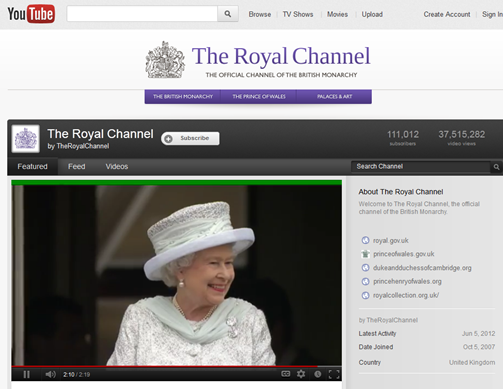
As of this afternoon, there were over 37.5 million views of the official Royal Channel on YouTube. Could this mean that the younger generation may be embracing the monarchy and all it stands for?
Of course, over the past few years, the British monarchy has used social media channels for announcements. From the Queen joining YouTube in 2007 to the Royals breaking protocol and releasing details of William and Kate’s wedding last year, there seems to be genuine desire to connect with different generations.
Togetherness, sharing and community were the key highlights of this weekend. If the British public can come together to celebrate our Monarch’s grand anniversary as a nation – well, that can only be a good thing. There has been much negativity in the news altogether too much recently. With the riots last year, increasing violence on the streets and crimes against each other galore, let’s hope that the feeling of goodwill amongst all men (and women) lasts.
Now that the Yahoo! and Bing Search Alliance transition has been completed in the UK, FR and IE markets, we are going to see the re-introduction of a Search product, originally brought to the market by Yahoo! in November 2010, call Rich Ads In Search. This product is targeted towards brand advertising in Paid Search and offers a richer, more dynamic experience for users when searching on advertisers brand terms.
So what are Rich Ads In Search? They are brand ads incorporating either a logo, video, site-links or form boxes to allow the searcher to engage with the ad, whilst not leaving the search results page. Videos expand to play within the search ad, logos and links are clickable and direct the user to the relevant landing pages of the site applicable to the messaging in the link. Brand owners dominate the North Ad positions in the listings, pushing any rival bidders to the East positions.
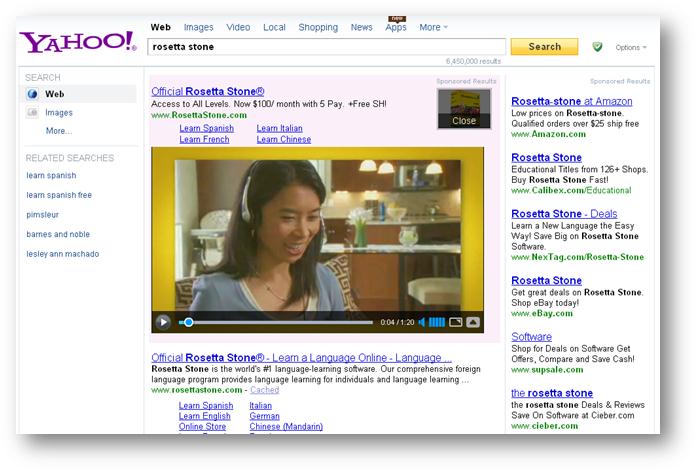
Having a logo or a video in the ad has proved to be successful in the US market when the product was released post Search Alliance transition, with ads experiencing increased in CTR of between 25% and 40% according to Microsoft data. Previously, only available on Yahoo! campaigns in the UK, Rich Ads in Search will soon be available through the adCenter platform, serving the more engaging brand ads simultaneously across Yahoo!’s results page and Bing results page.
The biggest enhancement for this product though, is the pricing. Previously the product was priced on a fixed tenancy basis for a fixed fee depending on the volume of searches forecasted. This proved challenging for advertisers to take advantage of the product as many advertisers were not in a position to offset fixed budget for a branding campaign without guaranteed delivery of impressions. This has now changed for the better and these Ad formats will now be available on a CPC basis, meaning this product is a ‘must have’ within any Brand campaign for Paid Search. It can be measured against traditional Search ROI metrics and optimised as a regular Search campaign would be.
This product is also ideally positioned between the Search and Display aspects of Digital Media buying. Advertisers can utilise Display or Offline creative assets in these Search campaigns, literally bringing TV ads or Display Videos to the Search page without having to go through a Video sharing website.
The product is currently being tested in the UK and is likely to be available to all advertisers in July 2012 managed through Microsoft’s adCenter technology platform.
Google Places is now ‘Google+ Local’. As of today - May 30th - these have now merged and when you are logged into Google+, (you are logged in aren’t you?) you can see a new tab which gives you access to this information. You don’t actually need to be logged in to benefit from some of the changes but you know Google wants you logged in, so there is more to be had when you are whether accessing via Search, Mobile or Maps.
Although somewhat less visible here in the UK, after a few searches I made, is the full integration of Zagat Reviews. Focusing on Hammersmith, the listings and reviews available were all as expected so no dramatic changes from Google Local.
What has changed apart from the Zagat integration and their scoring system replacing Google’s surprisingly older looking start ratings, is the inclusion of a circles filter that allows you to find reviews and recommendations from friends.
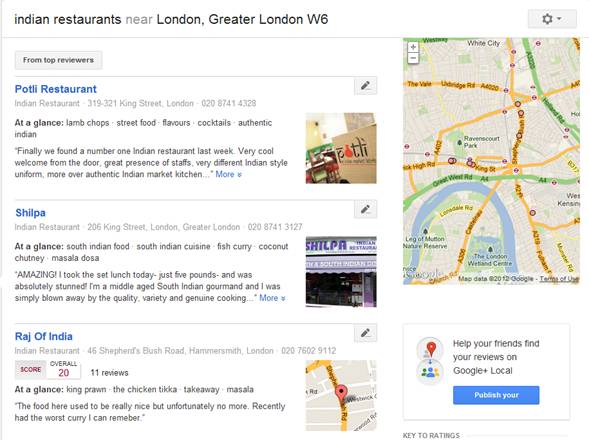
Perhaps the most interesting change will be the Socialisation of the Google+ Local pages, making them much more dynamic in terms of the interactivity they can have between business owners and users. Perhaps a valid challenge to the Facebook platform for those already engaging with both Facebook and Google+? And the word is that more functions will be rolling out. Have a look at the great in-depth review from Searchengineland here.
What this does mean is that business owners really will have to pay more attention to Google+. We have been saying for a while that Google is serious about Google+ and this really is a significant step pushing businesses onto what is an undoubtedly improving platform.
It looks like summer is finally here! (despite the predicted thunderstorms this week, but what’s summer in the UK without a splash or two of rain?). The first en masse celebration of summer 2012 will take place over the bank holiday weekend and it is, of course, the most patriotic of celebrations - the Queen’s Diamond Jubilee. We can’t wait for the street parties, concerts, river pageant and general merriment that will be happening during this weekend.
The office is looking suitably regal thanks to our lovely Lulu who has decked out the space with Union Jack bunting. We’re sure that this won’t be the last of the celebrations in the office for the Jubilee.

As an agency with a fair few clients, we are wondering what impact the Jubilee weekend will have on digital marketing. We have lots of ideas of how to make the most of these celebrations in terms of advertising (in a cost effective way).
We heard about the impact the Royal wedding last year had on digital from Google this week, as they have a few suggestions to help brands deal with the changes the bank holiday will make to digital marketing campaigns.
 Here are a few of their suggestions:
Step 1: Budget strategically for changes in volume
Step 2: Size your opportunity
Step 3: Focus on your Mobile/Tablet
Just a couple of months after the Jubilee, the Olympics will be on top of us and we will be glued to the TV sets while trying to navigate our way to work on the train… or if you are a tourist, just navigate!
With this in mind, we think that as the rate and volume of traffic heading towards Google Maps will be ridiculously high during this period, smartphone usage will be phenomenal in comparison to regular use rates.
This year’s events will have an incremental change on mobile search and commerce. Individuals will search more on their mobile devices, update their social networks and use them to navigate from one area of London to one of the many Olympic sites (if they were lucky enough to get tickets to the events of course).
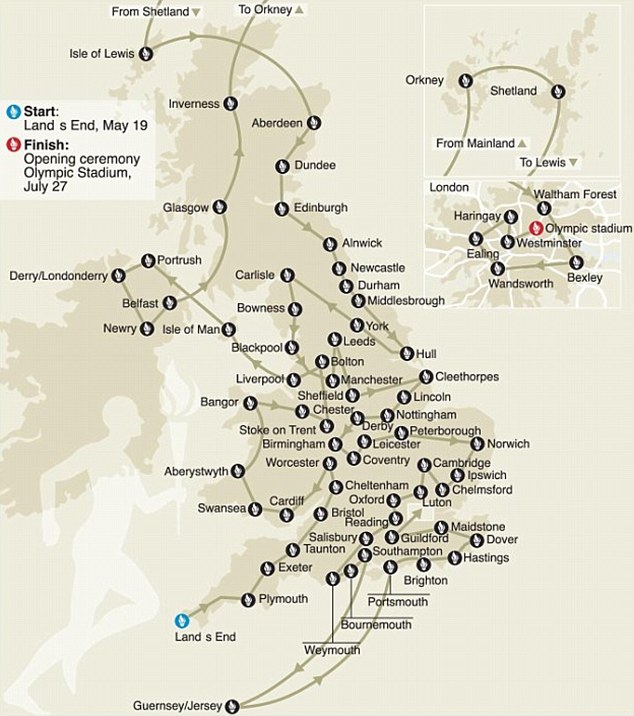
We are just as excited about the Olympic torch relay prior to start of the main event which is being navigated from the Temple of Hera in Olympia, Greece, to all over the UK
We have been checking out the map, to see if it is going past any of our homes…after all, how often will any of us be within less than a few metres of the Olympic flame in our lifetimes!? I for one, will be making sure I’m at home on July 7th when the torch passes my house!
As we all know, the deadline for businesses to comply with the EU’s Directive on electronic data privacy came into force last Saturday 26th May. In essence, the ICO (Information Commissioner’s Office) have said that every organisation that stores cookies on their website must ask their users for consent for their information to be stored. For example, Channel 4 (below) have asked visitors to their site to be aware that they use cookies on their site and visitors have the choice whether or not to accept it.
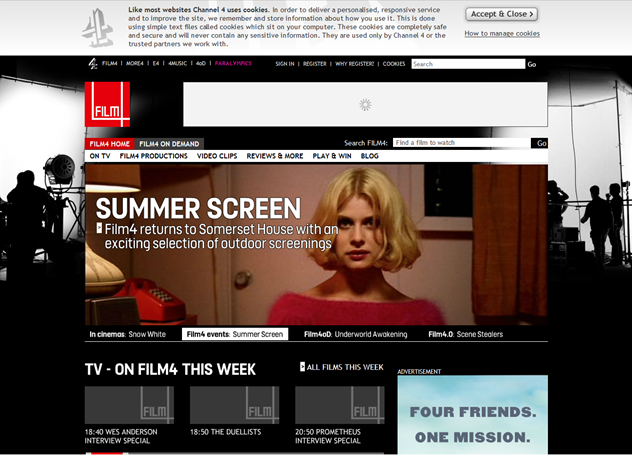
Even if the entire process hasn’t yet been completed, each organisation must, at the very least, show the steps that they’ve taken to comply with the legislation or they will be forced to accept the fines and consequences of falling foul of the law. Websites that break the rules can be fined as much as £500,000.
But what actually happened on the 26th? Did the axe fall on companies who didn’t comply? Did officers visit company HQ’s demanding explanations as to why they haven’t at least carried out an audit on cookies and handed out thousands of pounds worth of fines? In a word, no.
The ICO have said that they will send out 50 letters to the UK’s biggest websites this week. They will then wait for complaints to come in from members of the public about cookies on specific sites before investigating these organisations for flouting the data protection law.
Below are the options which the ICO are able to take “to change the behaviour of organisations and individuals that collect, use and keep personal information”. (www.ico.gov.uk)
It’s main options are:
- serve information notices requiring organisations to provide the Information Commissioner’s Office with specified information within a certain time period;
- issue undertakings committing an organisation to a particular course of action in order to improve its compliance;
- serve enforcement notices and ‘stop now’ orders where there has been a breach, requiring organisations to take (or refrain from taking) specified steps in order to ensure they comply with the law;
- conduct consensual assessments (audits) to check organisations are complying;
- serve assessment notices to conduct compulsory audits to assess whether organisations processing of personal data follows good practice (data protection only);
- issue monetary penalty notices, requiring organisations to pay up to £500,000 for serious breaches of the Data Protection Act occurring on or after 6 April 2010 or serious breaches of the Privacy and Electronic Communications Regulations;
- prosecute those who commit criminal offences under the Act; and
- report to Parliament on data protection issues of concern.
Considering that the majority of the Government’s websites haven’t complied either, I doubt very much that many organisations will face the £500,000 fine in the near future!
This is Google’s newest update. You have probably all heard about Panda, which was more targeted to content and content farms, whereas Penguin is targeting websites which appear to have spammy backlink profiles. It is aiming to penalise sites that seem to be manipulating the search results. So what does this mean for SEO?
This post will give an overview of the update, what it entails and a few ways to counter it.
What is Google going after? They are targeting sites which have:
- over-optimised anchor text - using the same keyword over and over in external content as the anchor text pointing to the site.
- guest posts on unnatural looking sites - while guest posts are a legitimate way of gaining links, content hosted on irrelevant blogs or low quality sites will be penalised.
- article syndication sites - as a reinforcement to Panda, Penguin will also be looking into links from article syndication websites and low quality article directory sites, as well as links from content farms.
- overtly spammy links
The main culprits which have been identified so far from the sites which have been hit are:
- blatant paid links
- content on link farms
- link exchange
The key indicators of the update are:
- ranking losses: keywords will no longer be ranking in high positions
- de-indexation of pages: web pages will no longer appear in Google

Some businesses are suffering badly from this update, to the point of losing their business.
An example which has been quoted on many Penguin update related articles is Oh My Dog Supplies, which has been hit by this update. This site used to rank highly in the US for keywords such as ‘dog beds’ and related terms. It is no longer visible for many of these keywords on the first few pages of the Google results, and according to the Wall Street Journal this business has lost 96% of its Google traffic and 64% of its revenue which was generated by natural search.
Why were they hit? The owner of the business admits to have paid for hundreds of links in 2011 and hosted content on sites such as EzineArticles.
How can you counter this update?
The first thing to state is that there is no quick fix. It is important to monitor your backlink profile. Anybody can link to a given site, be it good or bad links. Focus on creating quality content over quantity. Ask yourself ‘is this content that is shareable?’ Make sure your site is well optimised and try and build your site’s authority.
The quick answer to this is ‘it won’t’.
In the short term, Friday’s IPO won’t make a great deal of difference to the majority of brands on Facebook. In the long term I would expect Facebook to use some of the $16bn war chest they will have at their disposal to develop more features that brands can leverage to help build better and more valuable connections with their customers. They will certainly ramp up mobile which is an area they know they are not strong in, as more and more users are connecting to Facebook via smartphones and tablets. Brands will, of course, have to keep working their socks off to produce useful content that keeps their fans and customers interacting with them. 
In terms of advertising, we are going to see more of it! Advertising is how they make the bulk of their money and as a public company they are going to have to meet some aggressive growth targets each quarter for both revenue and net income. While General Motor’s decision to pull their advertising on Facebook isn’t really a big deal financially, it has highlighted the fact that currently, the response rates are weak compared to Google and advertisers who are looking for quick wins or sales won’t see the return they are after. However, Facebook aren’t short on brainpower and I think they will figure out the monetisation ‘problems’ pretty quickly and we’ll see some innovative ad formats appearing both on the site and through mobile.
I don’t claim to be an expert on the financial markets but it seems to me that as “the banks who led Facebook’s initial public offering – in which $16bn of shares were sold to new investors – were forced to move in to the market and buy shares in order to keep the price above the $38 level” (Forbes.com), the IPO wasn’t as much of a resounding success as we all thought it would be at the end of last week.
Google launched their Knowledge Graph in the US today. It’s such a straightforward tool that it’s amazing that it hasn’t been produced before by a search engine. Then again, perhaps it’s such a complicated piece of software that it may not have been possible before now!
The principle behind the Knowledge Graph is intelligent connections. It’s all about understanding the relationship between search terms based on real-life search results. The example they use in the video which they published today (see link) is that of Renaissance Art. If you are only aware of a single Renaissance painter e.g. Da Vinci, when you type in that name into Google’s search engine, as well as the standard search results which will come up, on the right hand side you will see a ‘side panel’ where you’ll see other areas which others have searched for in the past. For example, you may see a picture of the Mona Lisa, other artists, or famous paintings of that era. So it’s working on the idea that although you may want to know directly about Renaissance Art it’s fairly likely that you’ll want to know about the other aspects in that realm of knowledge.

Once you’ve had a look at all the options the side panel offers on Google, you will be able to select the link that’s most relevant to your particular search query.
Google have published a simple explanation of it here but when is it coming to the UK? No date has been set as yet but we wait with bated breath as opinion on the Knowledge Graph begins to trickle through from the US over the next few days.
Paid Search Advertising is an amazing marketing channel. In the last 10 years, billions of pounds have been invested in search marketing by clients and Google has emerged as both media owner and technology giant. Millions of UK consumers have clicked on ads and made a purchase via the tens of thousands of UK-based search advertisements. It’s an un-paralleled success story, from both a user and client point of view.
Despite massive growth and the UK’s aggressive search market, there are still too many marketers and clients who are not grasping its full potential. Search advertising offers the marketer significant benefits beyond pure direct response; adding to their understanding and knowledge of their customer and providing insight that can contribute to future strategy:

• Competitor understanding – by gaining knowledge of what your competitors are doing and understanding their target markets and keywords, you will be able to gain great insights. If you keep tracking your competitors’ listings, you can predict and achieve early insight into who is doing what and when.
• Understanding your own business and your margins – search is such a transparent piece of technology and it’s very simple to see what your business and market is strong in. Using tools such as Google Analytics can show you at a glance what is proving successful – and conversely – what isn’t.
• Modelling search spend and return– knowledge of search seasonality, the likely cost per click, a likely click through rate and the conversion rate means you can model media spend and likely return on investment. By layering in search volumes you can start deploying ‘what if?’ scenarios and top down scenarios.
• Optimising media spend for mass market new technologies e.g. mobile and tablet. There are new devices that are coming to market almost every day which allow for customised search campaigns. These strategies should always be different depending on which device you target – and can lead to startlingly good sales volumes.
• Understanding search in the wider marketing mix. Attribution modelling technologies are all the rage which can only have a positive influence on Search investment. For example, Ignition One, Marin and Kenshoo all give fantastic insight into the wider media marketing mix and can also optimise media spend.
As the market continues to evolve, grow and mature I’m sure that there will be new technologies, tools, knowledge sets and case studies that allow marketers to go beyond the virtual door drop methodology that seems so popular right now.
