


A Look at Bing’s Facebook Integration
As you may have heard Microsoft is rolling out in the US a revised version of Bing that includes a way to involve Facebook friends in the search process.
The move appears to be a response to Google’s “Search Plus Your World”, its own attempt at social integration, but it’s more than that. Bing believes it can make search better by enabling users to pose questions during the search process to Facebook users. This can be done through a new sidebar interface. It looks like this:
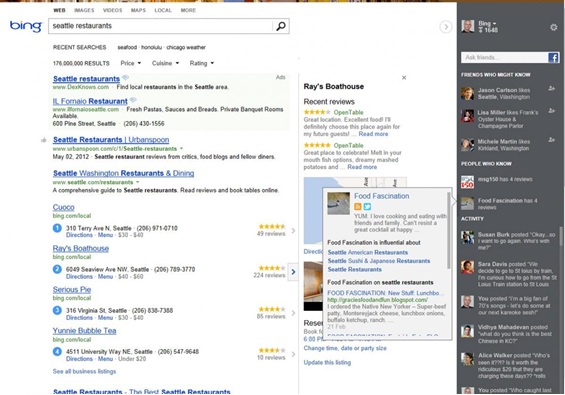
This is an example of a search for seattle restaurants. On the left you have the traditional paid & organic results. In the centre you have a “Snapshot area” which provides specific information like restaurant phone numbers, maps, hours of operation and reviews. On the right you have the “Social Sidebar”, where Bing pulls in its social results from not just Facebook but also Twitter, LinkedIn, and Google+, among others. Here you will be shown which of your friends are likely to be able to help with your query, together with a selection of experts who have blogged or tweeted about the topic you have searched for. Bing then enables you to start engaging with them without having to ever leave the engine.
How is this different from Google Search Plus Your World?
One major difference is that Google combines social results into their organic listing. The engine has been heavily criticised for force feeding Google+ on us, pushing Google+ results at the top of the page and ignoring more relevant results from other social networks, damaging the quality of their search results. Bing, on the other hand, leaves the social results to the side so that they complement the organic results without compromising them.
However, the biggest difference is that Bing is open to all social networks. As mentioned, the sidebar shows results from your Facebook, Twitter, LinkedIn and even your Google+ connections, so it has a level of depth Google cannot possibly match.
Benefits for Bing
Bing’s social integration is clearly an attempt at increasing market share. The company aims to do this in two ways. First of all, by becoming the default search engine on Facebook Bing will have access to the social network’s 900+ million users. As more and more people start searching on Facebook, more will start using Bing. In addition, the ability to consult through Facebook with friends and experts will enable Bing to become the perfect “Decision Engine”. Bing claims that 90% of people consult with a friend or expert before making a decision. If this were true, Bing would become the perfect place to go for people looking to buy something.
Benefits for Facebook
Having Bing’s search functionality allows Facebook to go one step further in becoming the all-encompassing internet website it aims to be.
Furthermore, the integration will help Facebook’s targeted marketing strategy. Now, rather than place tailored ads in its sidebar based on users’ personal info and “likes”, Facebook can in theory draw from their search habits to display related links and take a cut of any subsequent money spent on Bing. And who knows, if this tie up proves to be really successful then Facebook might even look at launching its own search engine.
Why is this important to Brands?
An increasing number of potential customers will now be exposed to brands’ Facebook content. Community managers for brands will have to keep this in mind because everything they publish through Facebook will have the potential to show up in search.
There’s also a great opportunity to gain customer insight. For example, trends will start to emerge around which types of content or commentary on Facebook, blogs, etc. have a higher likelihood of getting pulled into the social side bar (under ‘Friends Who Might Know’, but more important for companies under ‘People Who Know’). This can help inform the creation of content that has a good chance of being viewed in Bing’s eyes as authoritative.
Implications for agencies
Do not dismiss Bing. There is more to search than Google, and although Bing’s market share is currently low in Europe this move could be game changer. Facebook has the volume to make social search relevant and appealing through Bing in a way that will be out of reach for Google until its own social network can match Facebook’s user base.
Companies have to focus on creating great customer experiences. If you don’t have an effective strategy to engage with users in social environments, you will not be building the social signals that Bing is looking for. That means that if you launch a product that no one “Likes” you’re not going to show up in the search results.
B2B. Implications are so far limited for B2B advertising. But, as more people use Facebook for business by liking companies or industry stories, the database to power business-related Bing searches will increase. Therefore, to increase visibility in Bing it will be very important to link as many resources as possible to Facebook. The more likes you receive, the more likely you will be to show up in a Bing search.
